Sewing on a Singer 66.

I mentioned last week that I’ve been sewing on a Singer 66 foot-treadle sewing machine, so I thought I’d post a little bit about the machine.

My family has it because about thirty years ago one of my father’s co-workers bought a furnished house, and was going to throw this sewing machine away. My dad bought it from them for $10, and since then, it’s lived in my parents’ house in Connecticut. (That house had no electricity when I was a child, thus the mechanical sewing machine rather than an electric one.)

I learned to sew on this machine when I was around ten or twelve, and played with the foot treadle and base of the table before then: it made a great fort if you draped sheets around it and you were very, very small.

These days, it usually looks like a little table right next to the dining room table:
S66-Closed

When you remove the candles and runner, you can see that at some point in its history, it wasn’t treated all that well. One of my projects for this summer is to lightly sand off the existing finish and oil the wood, to help it be a little better protected from the sun. I did the same thing to my spinning wheel a couple of years ago: it takes focus, and willingness to do rather tedious, repetitive work, but the end result is completely worth it: the wood just gleams. But that’s in the future. For now, it looks like this:
S66-Closed-bare

Then you flip open the tabletop, which folds up to the left, and you see that this little table holds something rather more interesting than a drawer! Other than, of course, the four drawers it has on its sides, which are fabulous for holding thread and pins and needles and scissors and all the other notions you want to put somewhere close at hand. This machine is really well designed.
S66-Open-flat

You flip up the piece of wood closest to you, (which is unfortunately a little hard to tell in this picture):
S66-Open-One-Up

Then you look in: it’s a sewing machine! Lying on its side!
S66-Open-Look-In

You pull the machine up, and lift it just high enough that the front piece of wood goes beneath it: the machine rests on it, and stays up and solid. This is a really well-engineered machine, and it all fits together very well.
S66-Open-Up

From a little more of a distance, it looks like this:
S66-Open-Up-Full

Then you make sure the belt goes around the drive wheel, under the table, and check it’s seated properly around the machine’s wheel, and you’re almost ready to go. You can see the drive band in this picture: it’s the red thing that loops around the cast-iron wheel. When you treadle, the large wheel (let’s call it the drive wheel) goes around: the belt connects it to a smaller wheel on the machine, and a series of little gears and belts powers the machine, making the needle go up and down as you treadle.
S66-Treadle

Now you’re almost ready to sew! You thread the machine (and this is one of the places where looking at the manual I found online was helpful, as I was running the thread just a smidge wrong before:
S66-Open-Up-Threaded

The biggest difference for me in sewing on this machine, once I’d gotten it oiled properly and the tension adjusted (you turn the large knob on the head of the machine to adjust the top thread tension, and the bobbin thread just sort of does its own thing), is that you have to remember that your feet need to keep moving. Once it’s in the swing of things, this is easy enough: it’s trying to sew while the machine is still waking up (so to speak) that’s a chore. Sometimes I’d have to re-start the wheel by hand on each full rock of the treadle, because it stalled out, which was very annoying.

But I did learn to sew on this machine, so it came back to me — kind of like riding a bicycle, I suppose. It’s the same muscle-memory coming back to help you, after all. I still found that my seams are less precise (I don’t have a quarter-inch foot for this machine, for one thing, thus the masking tape) and that the fabric tends to drag more — I’m going to try buffing the bottom of the foot, to see if getting rid of some of the corrosion will help the fabric move more smoothly. Overall, though, it’s a fun project, and I’m really enjoying myself — I feel very lucky to get the chance to use this, and to also be able to go home and use an electric machine with a simple one-foot-pedal, which always seems so easy in comparison when I first get home!

If there’s anything in particular you’d like to know about the machine, just ask — if I know the answer, I’ll answer to the best of my ability!

I’m not sure when this machine was made: there are a lot of websites about the history of sewing machines, and they mostly seem to suggest that the Singer 66 model was made for a long period of time. I don’t know how to localize it more specifically than that.

Let’s end with a quick reminder about the Lets Get Acquainted Blog Hop on Plum and June. Today is the Monday link up!

Head on over to find out who will be posting this week, and check out their blogs on Tuesday and Thursday — you’ll find some really excellent tutorials and quilters this way.

Block of the Month Progress

I’m participating in Jeni (of In Color Order)’s Half-Square Triangle Block of the Month quilt along. So far I’ve finished the blocks up through April, and I can’t decide if the pinwheels or the flying geese are my favorites.

I am very proud of the way the pinwheels all line up in their centers, though.

I’m not stopping with April, of course. And I thought I had finished May’s block, before I realized that I had flipped two of the light-blue half-triangle squares. I took the one side section off, flipped it 180 degrees, and thought “There! Now the light blue triangles are facing the right direction!” And then I looked at it, and realized that now the corner blocks faced the wrong way.

I’m not very pleased by it right now, but once I’ve forgotten about the amount of ripping and re-sewing I had to do, I’ll probably be a lot happier with it. I’ll probably fix it over the weekend, and also get June’s block cut out, because it looks like one I’m going to like quite a bit.

I’ve been half-seriously considering doing two blocks for each month, to put together a larger quilt top when this is all over. Of course, that simply highlights the fact that I haven’t the faintest idea what on earth this quilt will be when I finish it: a gift for someone, presumably, but for who? I have no idea.

It’s funny: I appear to be very much a process quilter, while I’m sometimes a very product-oriented knitter or spinner. Who knew?

Mixtape Quilt

I’ve done a lot of piecework and blocks recently, but the project that’s taking up much of my time right now is one that hasn’t shown up here at all yet!

This is partially because I haven’t got the sashing material yet for my Simple Math quilt, so that’s on the shelf for a little while. (To pick out that fabric, I’ve got to find a time both its recipient and I are free to go to a quilting store, and that’s going to take some doing between our respective schedules.)

Fortunately, I haven’t had to sit on my hands. Instead I offered to make a quilt for a friend’s son. I sent her a handful of patterns, and I have to admit I was really pleased when she picked Mixtape Quilts, because I’ve been eyeing it for a little while. We went to The City Quilter together, and I read to her little boy while she picked out fabrics. It was really fun watching her duck from rack to rack accumulating fabrics and pairing them off.

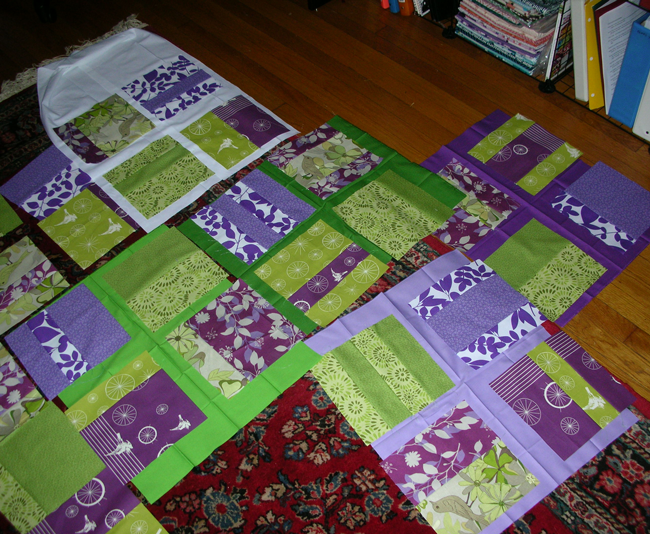
It’s all purples and greens, though the colors don’t come through true in these pictures:

We bought white material for the sashing, but after I’d laid all the blocks out, it occurred to me that maybe a darker sashing fabric would be a good idea for a small child? So I laid out what purples and greens I had (solids, that is) under some of the blocks:

(The lighter green isn’t quite that NEON in person…)

What’s funny is that everyone who saw it had a different, very strong opinion. Definitely NOT white. Definitely purple. NEVER green. Maybe a different green. NOT purple. It was a complete failure of crowd-sourcing decision-making: no consensus at all. The recipient went with white in the end, so I’m working on sewing it all together with the sashing right now, which ought to keep me busy for a little while.

Quilting the Nine-Patch Lattice Quilt

Well, this week has been a thorough fail in terms of posting on-schedule.

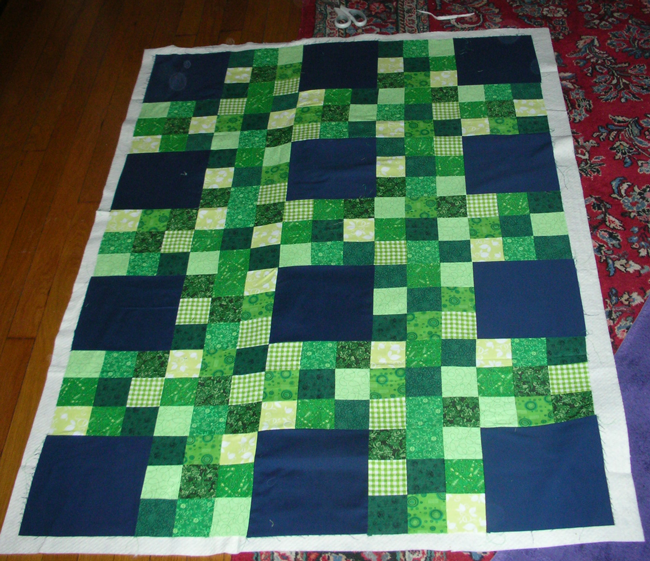
In any event, I’ve all but finished the Nine-Patch Lattice quilt, so here’s a look at how I quilted it. I followed the instructions in The Practical Guide to Patchwork, with the occasional look at Elizabeth Hartmann’s very helpful tutorials on her blog.

First I laid out my quilt batting and top, and rolled them together. (I forgot to take a picture of this step.)

Then I laid out the back, and while the instructions I was looking at suggested stretching the back out and taping the edges so it doesn’t move, I thought – hey, I can totally do this, it’s tiny! – not my best idea.

I unrolled the quilt batting&top onto the back, and trimmed around the edges.

I’d decided to quilt along the lattice design: nice straight lines seemed like a good idea for a first try at really quilting something. I initially thought of quilting all the lines, including those within the nine-patch blocks, but I decided I didn’t want it to look quite that busy. And the batting I was using said it could be quilted up to 10″ apart, so I didn’t feel too bad about these blocks.

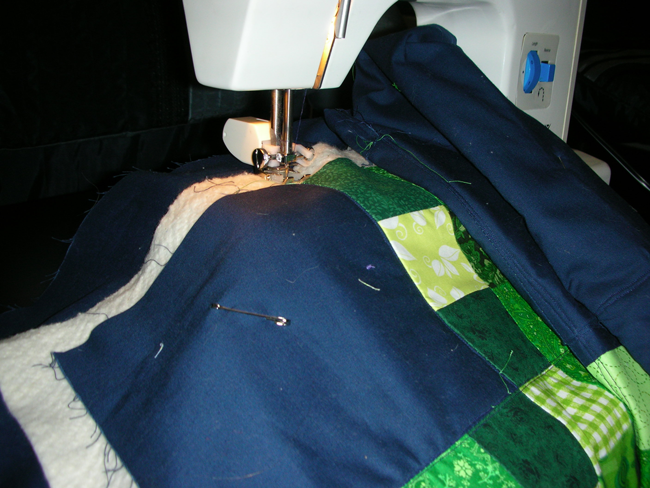
I attached a walking foot and a 14 needle (instead of an 11) and I started quilting along the lines of the lattice blocks. I started stitching on the batting, beyond the edge of the top’s fabric.

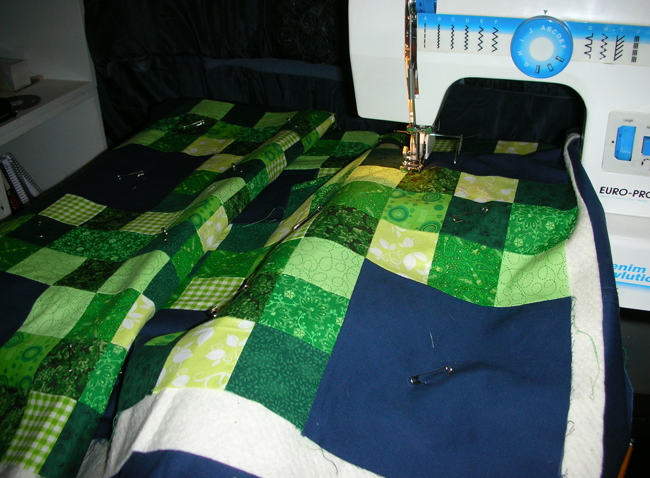
I rolled the quilt up as I went, and it’s a good thing it was fairly small, because it definitely took me a little while to figure out the most efficient ways to move it around.

One thing I didn’t think of for an embarrassingly long time is the idea of folding up not only the side that was going under the arm of the sewing machine, but the quilt on the left of the sewing machine as well. This made things a lot easier to manage.

Remember how I said I didn’t follow the instructions quite exactly? Well, it turns out that if you rely on just crawling around and smoothing, and you don’t really quite know exactly what you’re doing just yet, you end up with a couple of tucks in the fabric of the back of the quilt. I am surprisingly okay with this, because, really, for a first quilt (I really don’t count the two I made for my cousin’s kids, because they were so small and so completely without guidance or plan), it’s not that bad. But I still didn’t take pictures of the tucks on the back.

Once I’d finished quilting it, I trimmed the edges straight and cut and pressed my binding.

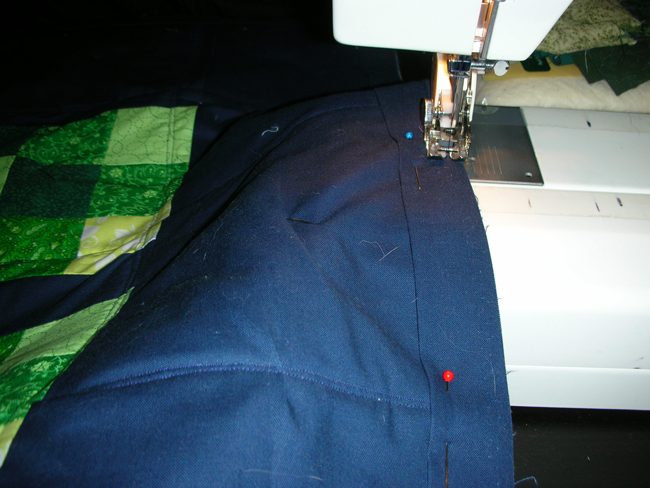
I pinned it to the wrong side, and sewed about 1/4″ from the edge, all the way around. One of the corners gave me some trouble (overstitching both sides of it? Not the best plan.)

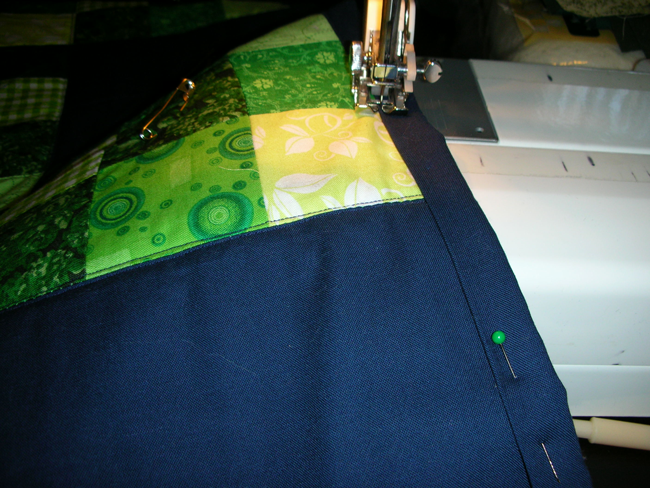
Then I unpinned it, turned the binding around to the front of the quilt, and pinned it down. Then I sewed the binding down about 1/4″ from the edge of it. This left a second line around the edges of the quilt on the back, but I don’t mind the effect, and it was a lot faster (and I trust it a lot more) than hand-stitching the binding. I have very little confidence in my ability to sew things by hand.

You may notice, in this last picture, that I managed to put the pins in with their sharp ends facing me: OW. Not doing that again, if I can help it. I stabbed myself on their tips more times than I really want to remember.

When I get some decent light, I’ll photograph the finished quilt. And now that the Lattice quilt is finished, I’m working on a quilt for a friend’s son. It’s all greens and purples, and I’ve already finished all the blocks for it.

Sizing up Simple Math

The Simple Math pattern (by Elizabeth Hartman of Oh, Fransson!) as written makes a finished quilt of about 47″ x 62″, made of 48 blocks. Now, I’m all for reasonable-sized projects (well, sometimes), but I wanted to make it in a size I’d actually use on a bed: I’ve got enough lap blankets knit up to last me quite some time, and I’m not much for hanging quilts on the wall. (Well. Not yet, at least.)

I figured out that if I wanted to make a quilt roughly twin sized, I’d need to make 80 blocks. Well, I thought — I’m well on my way! Look, I have 64 of them done!


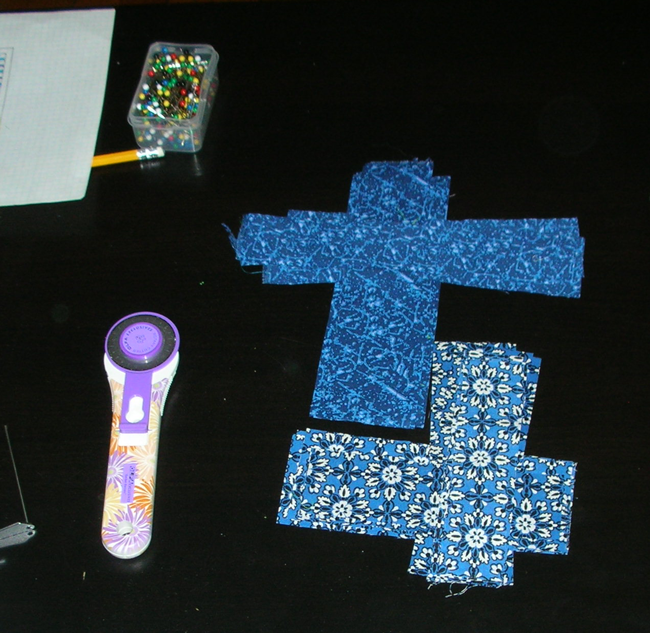
All right, so it doesn’t look very impressive in those little bitty stacks. But that’s still 64 6.5″ square crosses right there!

And I only have two more colors to go, to get this all cut and sewn, see?

And then my mother (for whom I’m making this quilt) said: “Well, we don’t really need a twin size quilt. What about a full size one for the guest room?”

So I agreed, sighed, looked at the pattern, and drew myself a new mock-up. This one takes 120 blocks:

Here’s my logic in putting this diagram together.

I’m putting 2″ strips between the blocks, so that works out to 1.5″ of sashing on each side of a block (assume 1/4″ seams). The blocks are squared to 6.5″, so they will be 6″ square, if I put them together properly. This means I can increase this pattern by increments of 7.5″ (6″ block + 1.5″ sashing) So I did that, and increased it in size to 10 x 12 rows of blocks.

You’ll notice one other difference from the pattern as written: I decided to add a striped border using the scraps from the fat quarter fabrics. It will be 3″ wide, striping blues and the white background fabric. The white stripes will always be 3″ square, but the blues will vary in width from 1 1/2″ to 2 1/2″, in the same increments as the crosses. I’m looking forward to piecing that part together, though I suspect I’m going to hate it just a little bit when I’m putting it together.

That striped border adds 3″ to each side of the quilt, for a total of 6″. But then I wanted to be sure I had plenty of material around the edge of the quilt to trim and still have enough room to sew on the binding without it obscuring the stripes. So I added in a 3″ strip of sashing around the outside of my impromptu striped border, which adds another 6″ to the final dimensions.

And when you do the math for all of that, the finished quilt ends up being a whopping 88.5″ x 103.5″

I’m a little daunted by the idea of quilting all of that, but I’m pretty sure I know how I’m going to do it, so that part, at least, is a little less scary.

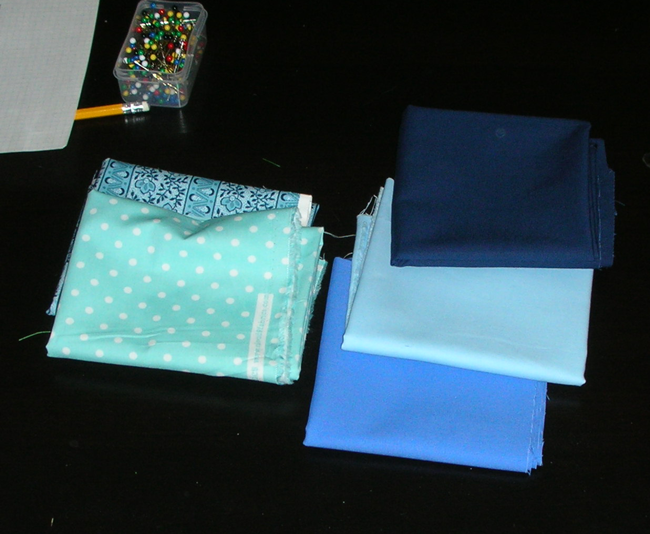
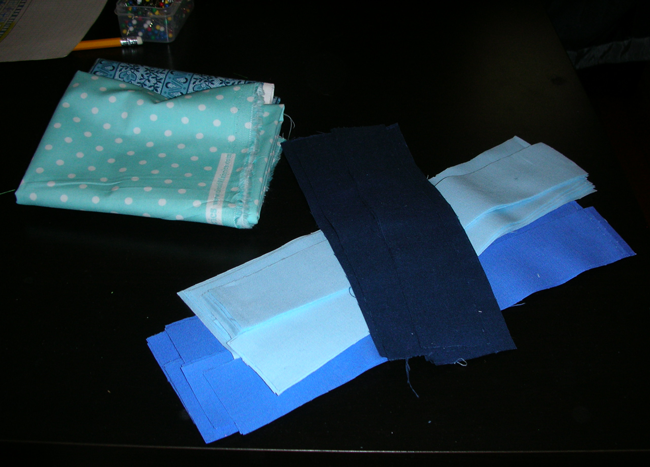
Of course, increasing from 80 to 120 blocks doesn’t just happen by itself. So I walked over to the fabric store, and picked up three solids and two prints, to make another 40 blocks:

The solids are Kona cotton, the prints are whatever happened to be in the fat quarter bin and caught my eye.

I’ve cut three of them so far, but then the draft deadline for the paper that will become my thesis called, and I’ve paused right now, about to cut out the stripes from the last two fat quarters, and then cut 40 more 6″x6″ white blocks for the backgrounds of all those new crosses. I’m just glad I have a few extra yards of this white background fabric: otherwise I would be very, very sad.

I guess it’s not called frogging when you quilt, huh?

Just a short post today, because I have a 25-page paper due tomorrow.

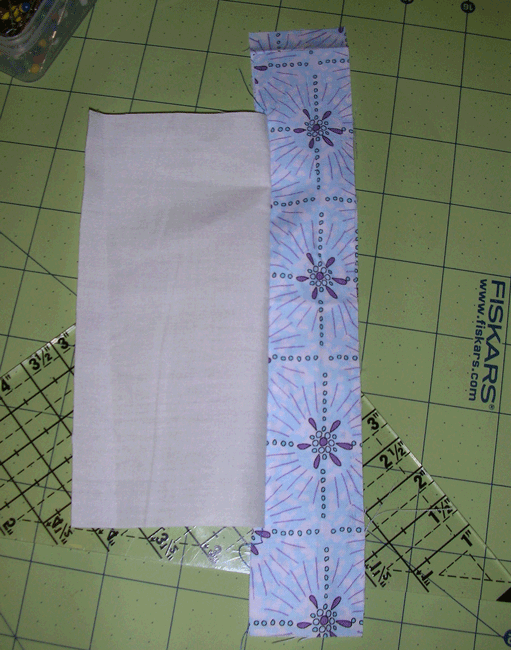
So you know how you get into a rhythm of something, and it starts to feel almost automatic? I was in that state earlier when I was working on a set of blocks for my Simple Math quilt. Then I looked down at what I was working on.

What’s wrong with this picture?

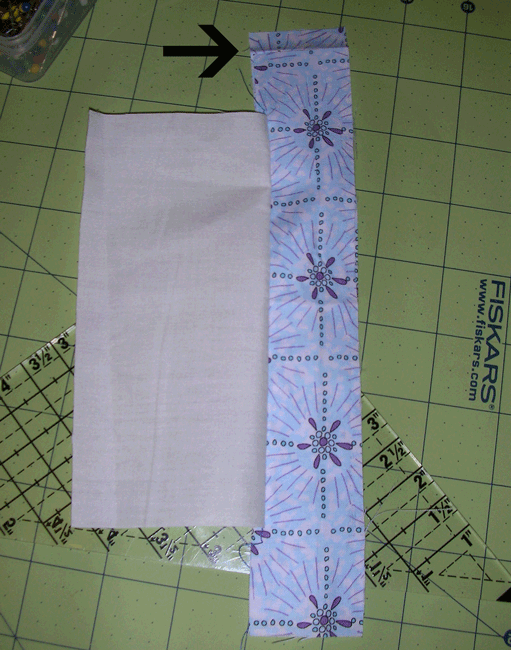
Let me help:

Do you see it now?

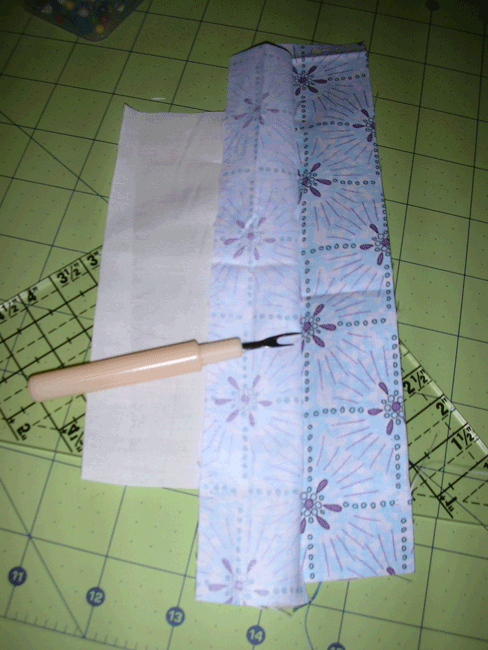
I wasn’t paying close enough attention, and sewed both color strips in place of just one of them. So I got to make friends with my seam ripper. I think we’re both the better for it. I’ve ripped out a couple of other blocks since then, to make them line up square in the center. It may not look that bad, but I would much rather re-do it now than look at the quilt months from now and see only the mistakes I didn’t fix.

And of course, my mother (for whom I’m making this quilt) decided a few days ago that, really, they don’t have any twin beds that need quilts. But there is the double bed in the guestroom…

So I got to do all the math to size up the Simple Math quilt not just to twin size, but again up to full, and to find the fabric I needed to make the extra blocks I hadn’t counted on at first. My scanner is being stubborn this morning, so I’ll scan in my drawings later this week.