Quilted coasters

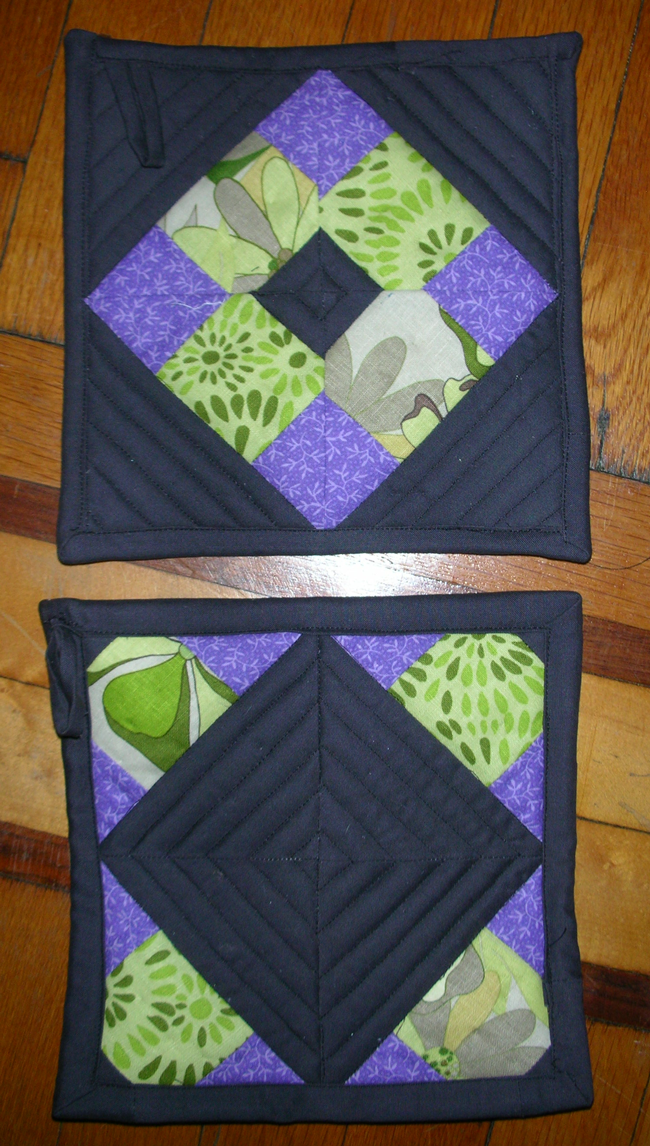
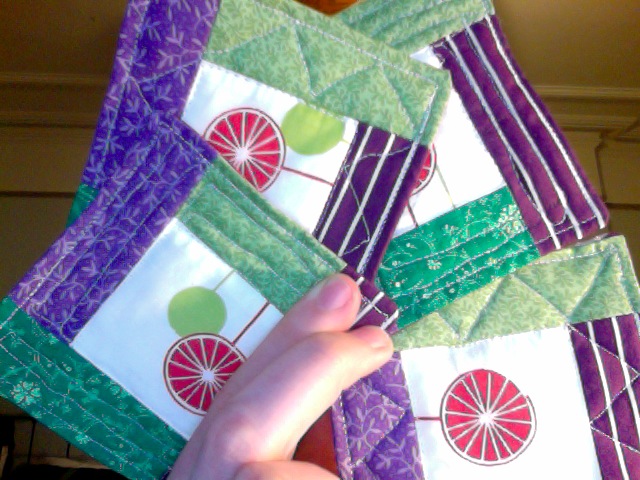
Following this tutorial, by Jeni of In Color Order, I spent a little while last week putting together and quilting four little coasters.

It was a great chance to try out free-motion quilting for the first time. Most of what I learned was: I need way more practice at this. So there may be more coasters and so on in my immediate future, since they seem to make a nice tiny little playground for trying my hand at free-motion quilting.

Quilt-alongs

You may have noticed the three icons that have popped up in the sidebar. The first one is the My Precious Quilt-Along, which challenges you to use some of that fabric you just can’t get yourself to use — something old, or rare, or out of print, or just something you’ve been hoarding instead of using. I think it’s a fantastic idea, and I’ve loved poking through the images to see what fabrics people have been hoarding.

It’s hard to call my behavior true hoarding when I’ve only been quilting for a little over a month, but there are fabrics in my little stash that I look at and take out and pet and look at, and then put away carefully because WHAT IF I MESS THEM UP!? I had thought that knitting and spinning had cured me of my desire to keep the pretty things instead of using them, because I’m pretty good about knitting with or spinning up that really pretty yarn or fiber. But it turns out that’s really not the case at all when it comes to fabric: I get all grabby and want to just leave them on the shelf, because they’re pretty there, and clearly I’m not nearly a good enough quilter yet to merit using these fabrics.

The ones I’m most inclined to put back on the shelves just in case are from the 1001 Peeps collection, by Lizzy House. It’s not super-old (it seems to have come out in early 2011), but some of the prints are getting harder to find, so I hope it qualifies for the QAL.

I used a tiny bit of it for some Simple Math blocks, but for the My Precious QAL, I’m challenging myself to use more than one of the prints, in more than just a teeny strip. In other words, get that precious fabric off the shelf, and into a quilt. It was like pulling teeth, to get myself to actually pull even just a few of the prints off the shelf and into the queue for the Block of the Month quilt. I’ve ended up echoing the colors of the Blocks of the Month QAL over at In Color Order.


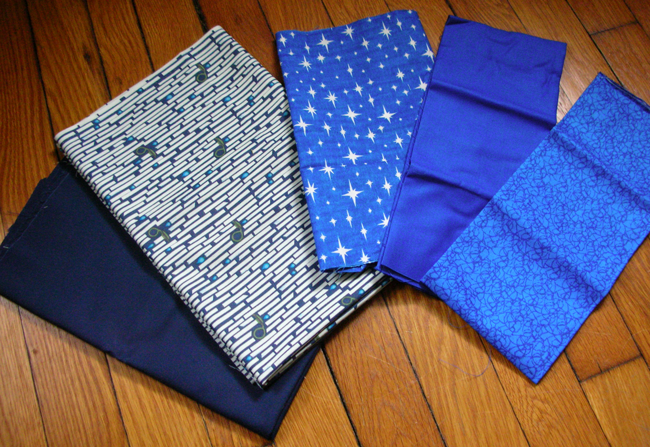
The only one here that I’m worried about messing up is the Illuminate.


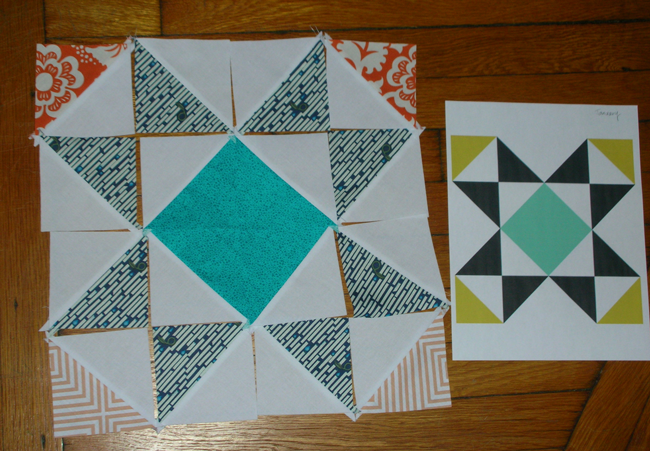
Here I’ve got two from the 1001 Peeps collection: Peeps and towers, both of which I’m very fond of. I’m hoping I can sort of fussy-cut a little bit to get people in the triangles.


Here, again, is the Illuminate print, which I thought was too pale for the oranges. We’ll see how it works out in practice.


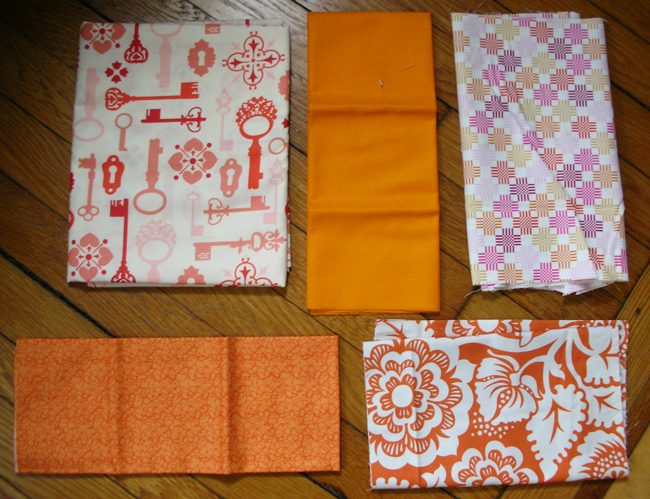
I’m going to swap out the orange print with crosses or the one with keys for the Scheherazade print in orange, because it’ll provide more of a contrast with the white half-triangles. It only took me sleeping on it for a night to decide that, yes, I could use that one, really. Apparently I really do want to keep some of these fabrics on the shelf.

And then I’ll have one of the prints I’m all grabby-hands about in each color group.

The third button, the Retro Flower QAL, is more of an aspirational project — once I work myself up to the idea of quilting curves, I’ll get going on it. For now, it sits in the sidebar to remind me that there are always new things to learn.

Henrietta Turtle

No in-process photographs for this one, I’m afraid: I was so caught up in making it that the camera didn’t make its way out at all.

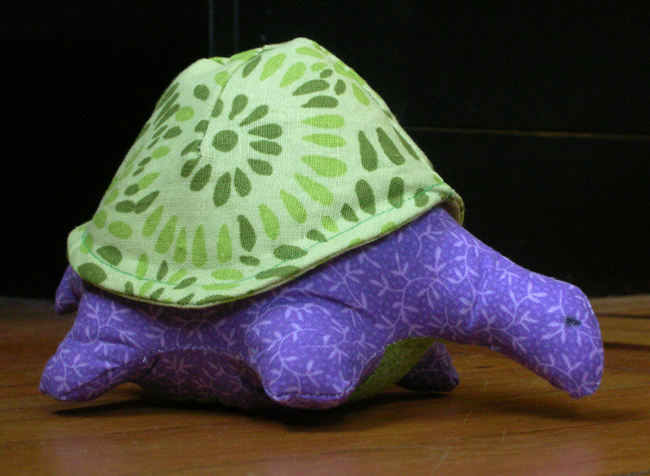
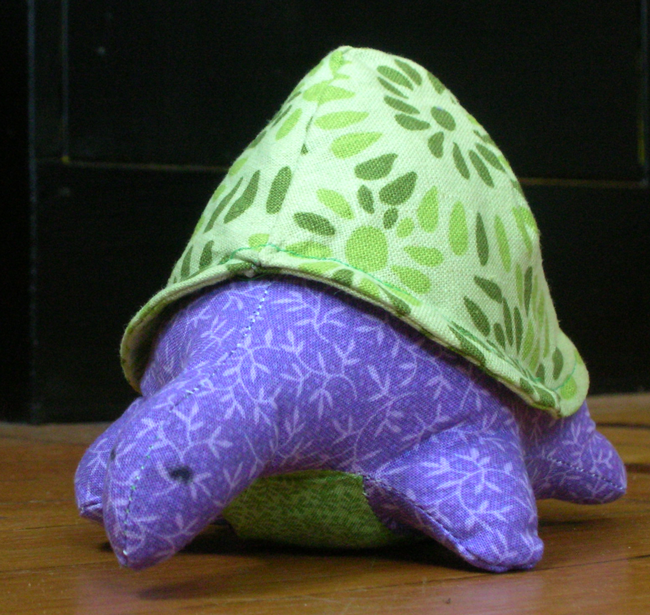
This is the Henrietta Turtle by Heather Bailey, made from scraps from the Mixtape quilt I posted about on Wednesday.

The little boy I’m making the mixtape quilt for fell in love with the stuffed turtle at the City Quilter, so when I stopped back in to get fabric for backing, I picked up the pattern.

This was a delight: the instructions were clear and easy to follow. And that’s saying something, because this is the first time I’ve sewn curves since my grandmother taught me how when I was a kid.

I only changed one thing: instead of french knot eyes, which I know will end up unraveling, I simply drew on the eyes with a permanent marker. Not nearly so nice, but much less destroyable.

Mixtape Quilt

I’ve done a lot of piecework and blocks recently, but the project that’s taking up much of my time right now is one that hasn’t shown up here at all yet!

This is partially because I haven’t got the sashing material yet for my Simple Math quilt, so that’s on the shelf for a little while. (To pick out that fabric, I’ve got to find a time both its recipient and I are free to go to a quilting store, and that’s going to take some doing between our respective schedules.)

Fortunately, I haven’t had to sit on my hands. Instead I offered to make a quilt for a friend’s son. I sent her a handful of patterns, and I have to admit I was really pleased when she picked Mixtape Quilts, because I’ve been eyeing it for a little while. We went to The City Quilter together, and I read to her little boy while she picked out fabrics. It was really fun watching her duck from rack to rack accumulating fabrics and pairing them off.

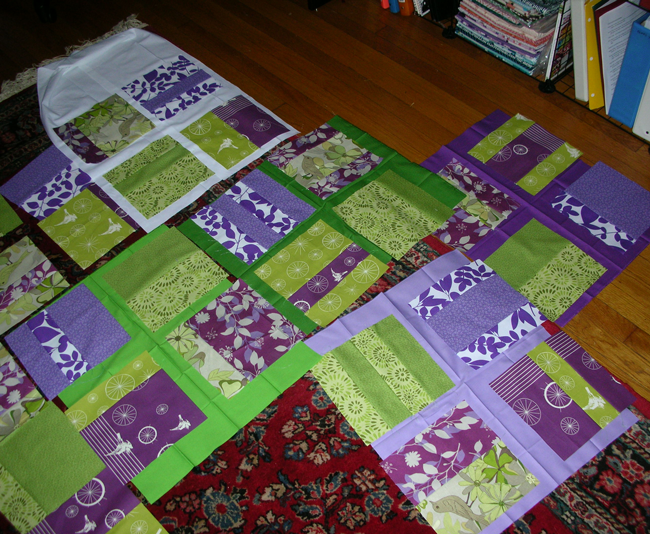
It’s all purples and greens, though the colors don’t come through true in these pictures:

We bought white material for the sashing, but after I’d laid all the blocks out, it occurred to me that maybe a darker sashing fabric would be a good idea for a small child? So I laid out what purples and greens I had (solids, that is) under some of the blocks:

(The lighter green isn’t quite that NEON in person…)

What’s funny is that everyone who saw it had a different, very strong opinion. Definitely NOT white. Definitely purple. NEVER green. Maybe a different green. NOT purple. It was a complete failure of crowd-sourcing decision-making: no consensus at all. The recipient went with white in the end, so I’m working on sewing it all together with the sashing right now, which ought to keep me busy for a little while.

Finished quilt!

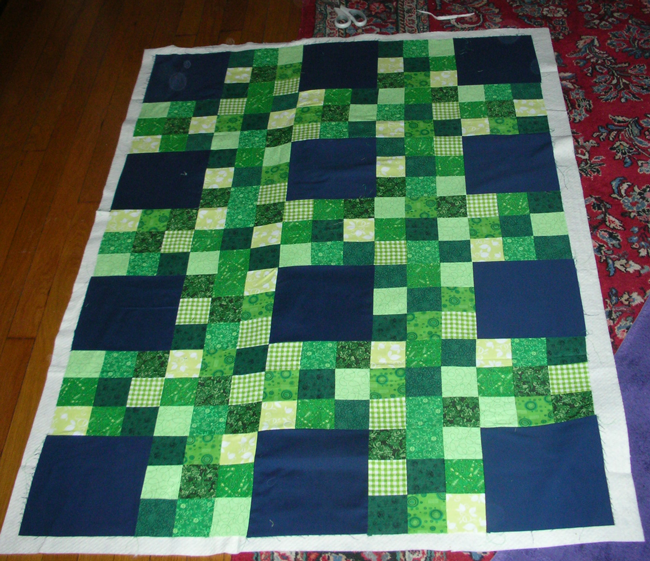
It’s finished! I’m really very proud of it. And I still love the back, the way the four nine-patch panels sort of hover:

I quilted it along the seams, and it doesn’t show up much on the front, but I like the grid it creates on the back: (ignore the fact that I didn’t brush off all the thread scraps, please!)

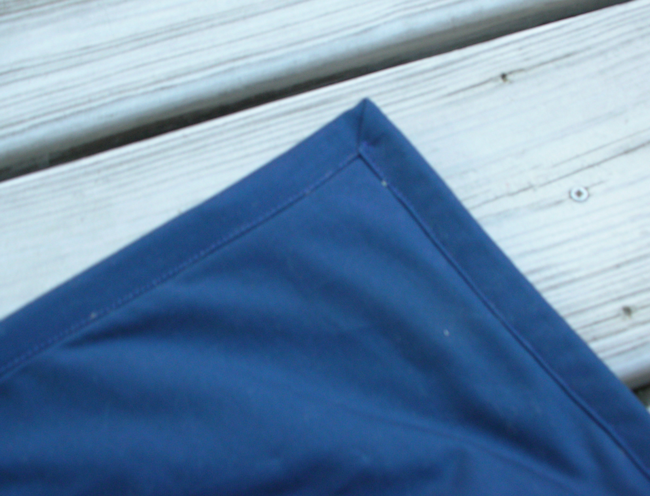
I’m really pleased with the way the corners came out. This is the top side:

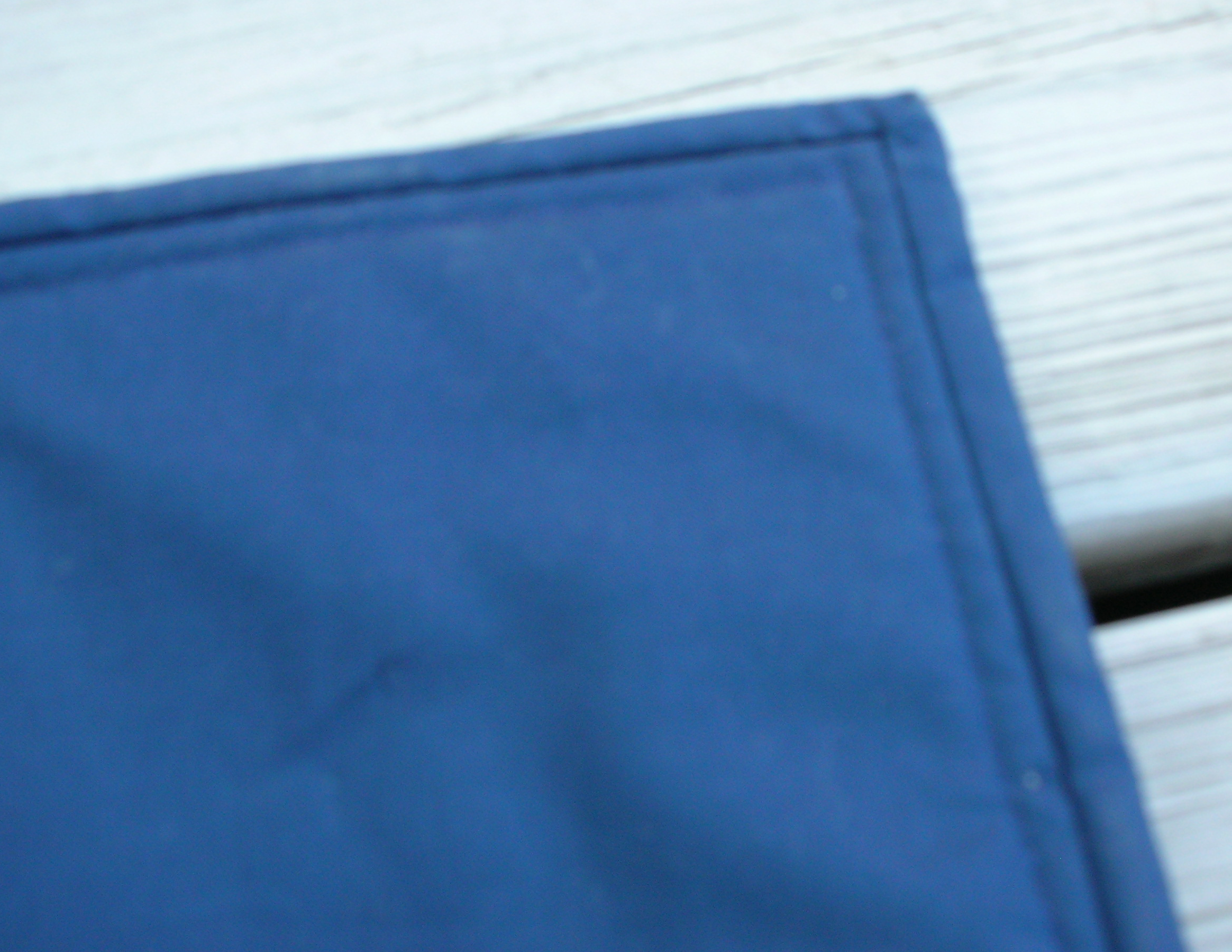
And this (blurry) picture is the back of the quilt, and you can sort of see the way the binding folds over, and 1/4″ inside that (give or take) there’s a line of stitching from where it’s sewn down on the front of the quilt. I kind of like the look of it.

So that’s the quilt I’m considering as my first quilt, since it’s the first time I’ve followed a pattern or really known what I was doing. :)

Now I just need to figure out what to do with it…

Quilting the Nine-Patch Lattice Quilt

Well, this week has been a thorough fail in terms of posting on-schedule.

In any event, I’ve all but finished the Nine-Patch Lattice quilt, so here’s a look at how I quilted it. I followed the instructions in The Practical Guide to Patchwork, with the occasional look at Elizabeth Hartmann’s very helpful tutorials on her blog.

First I laid out my quilt batting and top, and rolled them together. (I forgot to take a picture of this step.)

Then I laid out the back, and while the instructions I was looking at suggested stretching the back out and taping the edges so it doesn’t move, I thought – hey, I can totally do this, it’s tiny! – not my best idea.

I unrolled the quilt batting&top onto the back, and trimmed around the edges.

I’d decided to quilt along the lattice design: nice straight lines seemed like a good idea for a first try at really quilting something. I initially thought of quilting all the lines, including those within the nine-patch blocks, but I decided I didn’t want it to look quite that busy. And the batting I was using said it could be quilted up to 10″ apart, so I didn’t feel too bad about these blocks.

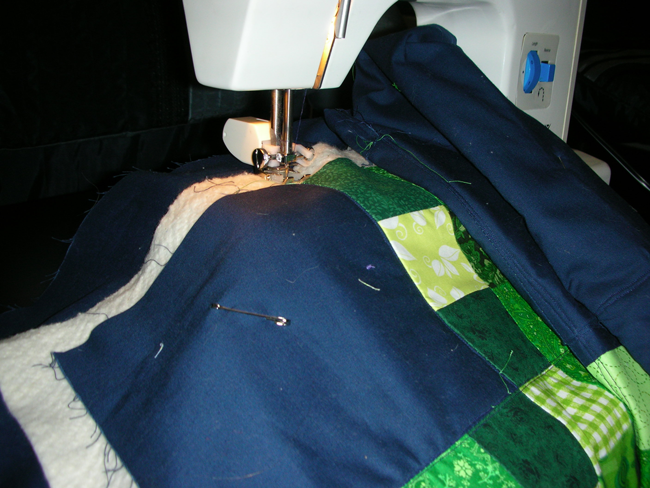
I attached a walking foot and a 14 needle (instead of an 11) and I started quilting along the lines of the lattice blocks. I started stitching on the batting, beyond the edge of the top’s fabric.
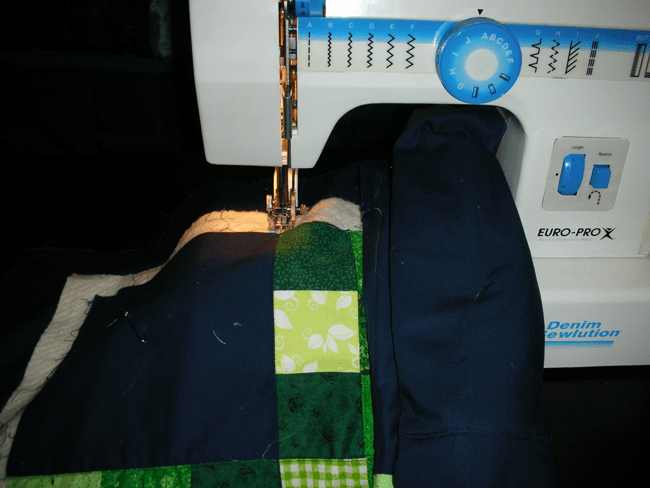
I rolled the quilt up as I went, and it’s a good thing it was fairly small, because it definitely took me a little while to figure out the most efficient ways to move it around.

One thing I didn’t think of for an embarrassingly long time is the idea of folding up not only the side that was going under the arm of the sewing machine, but the quilt on the left of the sewing machine as well. This made things a lot easier to manage.
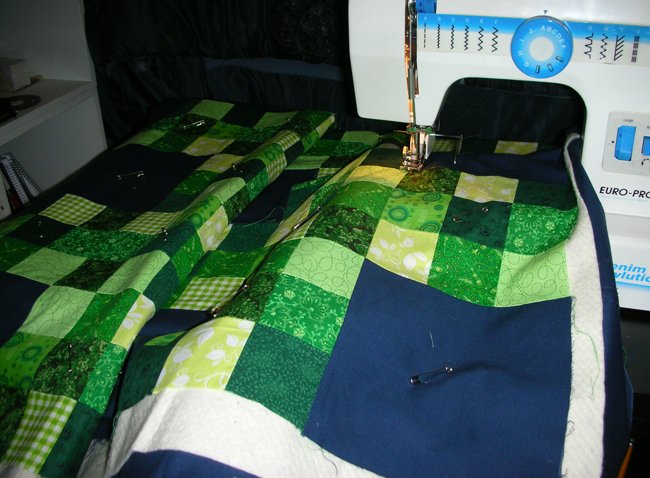
Remember how I said I didn’t follow the instructions quite exactly? Well, it turns out that if you rely on just crawling around and smoothing, and you don’t really quite know exactly what you’re doing just yet, you end up with a couple of tucks in the fabric of the back of the quilt. I am surprisingly okay with this, because, really, for a first quilt (I really don’t count the two I made for my cousin’s kids, because they were so small and so completely without guidance or plan), it’s not that bad. But I still didn’t take pictures of the tucks on the back.

Once I’d finished quilting it, I trimmed the edges straight and cut and pressed my binding.

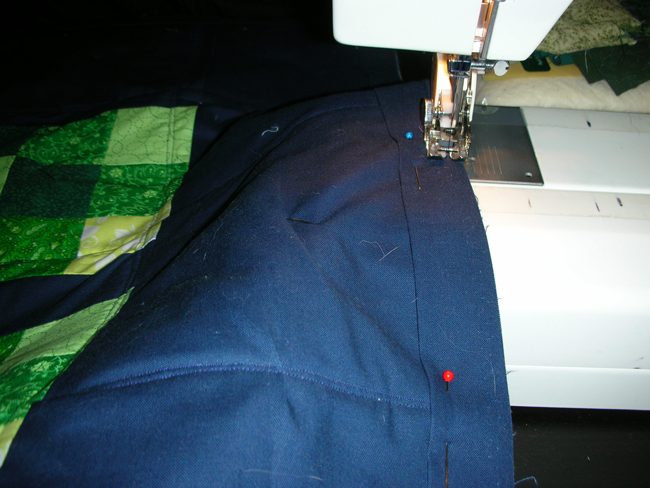
I pinned it to the wrong side, and sewed about 1/4″ from the edge, all the way around. One of the corners gave me some trouble (overstitching both sides of it? Not the best plan.)

Then I unpinned it, turned the binding around to the front of the quilt, and pinned it down. Then I sewed the binding down about 1/4″ from the edge of it. This left a second line around the edges of the quilt on the back, but I don’t mind the effect, and it was a lot faster (and I trust it a lot more) than hand-stitching the binding. I have very little confidence in my ability to sew things by hand.
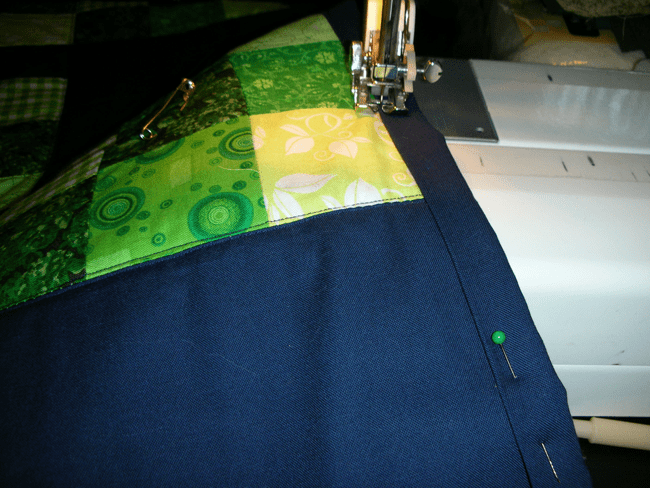
You may notice, in this last picture, that I managed to put the pins in with their sharp ends facing me: OW. Not doing that again, if I can help it. I stabbed myself on their tips more times than I really want to remember.

When I get some decent light, I’ll photograph the finished quilt. And now that the Lattice quilt is finished, I’m working on a quilt for a friend’s son. It’s all greens and purples, and I’ve already finished all the blocks for it.
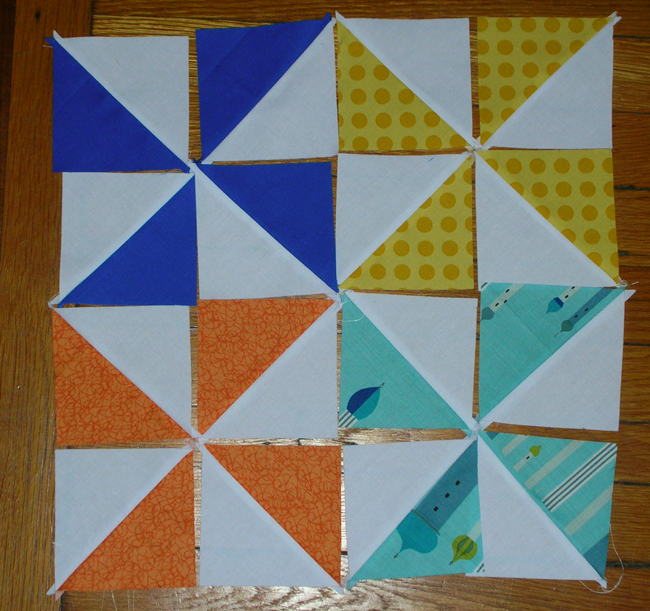
Simple Math blocks completed!

Those four stacks are all one hundred twenty (120!!) blocks for my adapted-to-double-size Simple Math quilt. There are four widths of crosses: 1″, 1 1/4″, 1 1/2″ and 2″. There are fifteen fabrics total, and two patches in each width in each fabric.

I made up blocks in five patterns each of light, medium and dark fabrics.

Here are the light-colored fabrics I used:

The center block in the back row is Kona cotton, because I wanted to add a solid to each group. The one in the back right is from the fat quarter bin at my local fabric store. The other three came from Jo-Ann fabrics sometime in the last four years.

Next up are the medium fabrics:

The center top is a Kona cotton solid again, and the bottom left is from the local fat quarter bin. The other three? Same as above.

And the dark fabrics, which might be my favorite:

Top right is the Kona cotton solid, which looks black here, but is actually the same deep blue as the Nine-Patch Lattice Quilt I made last month. Bottom right is Illuminate, from Lizzy House’s 1001 Peeps collection. I love the whole collection, so when one of the generic calicos I had for this didn’t work out, I was pleased to be able to pull this one in.


But now that they’re all done, they’re actually going to have to sit for a little while, until I can find a time when both my mother and myself can get to a fabric store together to pick a sashing fabric (and a backing fabric!). Once that’s all done, I can start putting them all together and worrying about how to quilt it properly. (I have some ideas, but they have to wait until I’m sure I know what I’m doing…)

In the mean time, I still have to quilt my Nine-Patch Lattice quilt, and I’ve started another quilt for a friend’s son, which will show up next time.

Knitting stash mini-tour

I tend to acquire things and hang onto them. With books, okay, that’s fine. I just finished my MLS, I’m in graduate school in medieval history: books are easy to justify. With yarn and fiber, however… well, I’ve been knitting for about eight or nine years now, and spinning just a couple fewer. And in that time I’ve gone to Rhinebeck and a couple of local fiber fairs in Indiana and lived near lovely, wonderful, friendly LYSes that had great sales. Turns out, that all adds up. They say a picture’s worth a thousand words, right?

That’s all the yarn and fiber I own, all in one place. There was a time when I would have looked at a photograph like that and thought “Man, is she nuts, or what?” Now I look at it and think that, but I also sometimes think “but there’s nothing I want to work on!”

In case it’s hard to see what’s going on in that enormous set of wire racks, here’s a mini-tour of the yarn. (I’ll do fiber and fabric on another day.)

Today we’ll start with the lower half, which is all yarn.

In the lower-right-hand corner, there’s all the yarn that is destined to become sweaters. The brown will be the Indigo Playmate sweater from Wendy Bernard’s Custom Knits. The blue and purple will both be cabled cardigans, though I haven’t settled on a pattern or design for either of them. The red are balls that go with a cabled cardigan I’ve got on the shelf for now: it’s about halfway finished, and I’ll love it when it’s done, but right now it’s driving me crazy.


The other main collection of commercial yarn is my stash of sock yarn:

The purpley-grey in the top right does not want to be socks, so I’m planning on making it into some kind of wrap or scarf. The Lorna’s Laces below it (light blue and black) pools like crazy if I knit it into socks my size, so I’ll have to find someone with small feet whom I like enough to give hand-knit socks. (Sadly, this rules out absolutely every member of my immediate family. We all have huge feet.) The ones I’m looking forward to knitting with the most are the two greens. (Well, and the second skein of Claudia hand-painted, because it’s so sproingy!)

The majority of the rest of my yarn stash is handspun. There are the natural-colored yarns:


The lighter yarn is for a sweater: probably the Tangled Yoke Cardigan, if I got the yardage and weight of the yarn right. The darker is for colorwork with a lighter yarn that I haven’t finished yet.

There are the dyed yarns:

The enormous green skeins are enough for a sweater for someone else, but not for me — there is a downside to being 5’11” with long arms and a long torso, and it’s that spinning up for a sweater takes a little longer. The white-pink-green-yellow is probably going to be socks for a child: I dyed the fiber with easter egg dyes and it ended up a little too pastel for my taste. The rest mostly tend toward lace-weight, so I’ll be knitting a good number of light, lace pieces in the future.

Overall, I love spinning with color, but I find it hard to get enough fiber to make any particularly sizable project — and I only need so many hats and mittens, even in the Northeast.

If you happen to spin, what do you do with small quantities of handspun yarn? If you don’t spin, what would you like to do with it, if you had a couple hundred yards of handspun colorful yarn?